
Holdover vs. Month-to-Month: What Happens When Your Commercial Lease Ends?
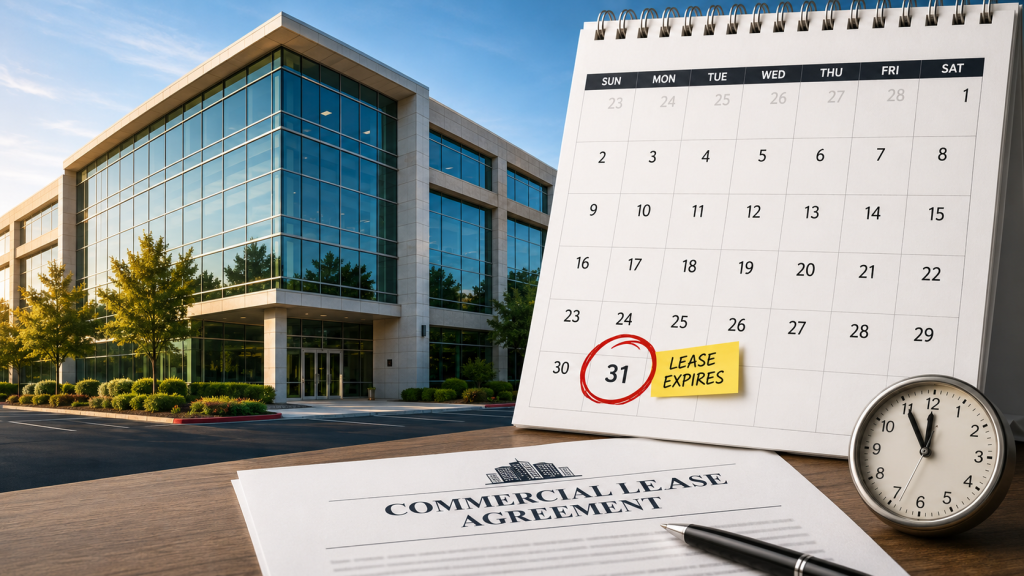
Your lease has an end date, but your business does not stop on that date. Maybe the renewal is still being worked out. Maybe the new space is not ready. Maybe you simply have not decided yet. So what happens if you are still in the building when the term runs out?
Here is the short answer: you can go month-to-month after a lease ends, but only if you and the landlord agree to it in writing first. Without that agreement, staying past the expiration date usually triggers a holdover, and a holdover is the costly version of the same situation. The gap between the two is the difference between a controlled bridge and a penalty you did not see coming. For a professional services firm with a multi-year lease, that gap can be worth tens of thousands of dollars.
The holdover is the default you never chose
When a tenant stays past the lease expiration without a signed extension or renewal, the lease’s holdover clause takes over. Most commercial leases in Southern California write that clause to discourage exactly that behavior. Holdover rent commonly runs from 150 percent to as much as 300 percent of the prior base rent, and it can apply even when the landlord knows you are still there.
The penalty is intentional. Landlords use it to protect their ability to re-lease the space and to push tenants toward a decision. Some holdover clauses go further and expose you to consequential damages if the landlord loses an incoming tenant because you would not vacate. That is a genuine risk for any business that planned to figure it out next month.
There is a common misunderstanding worth clearing up here. Many leases describe the holdover itself as a month-to-month tenancy, just at the inflated rate. A cooperative landlord can technically let you stay month-to-month while still charging the full penalty. The label alone tells you almost nothing. The rate attached to it is what counts.
A holdover is not a plan. It is what happens when the calendar wins.
A negotiated month-to-month is the version worth having
The better path is to ask for it before the lease ends. A month-to-month tenancy, sometimes built directly into the lease, lets you stay on a rolling basis at a defined rate with a defined notice period, usually 30 days from either side. The rate might be your existing rent, a modest step-up, or a number you negotiate. What matters is that you know it in advance.
This arrangement buys time without the punishment. A law firm waiting on a build-out, an accounting practice mid-merger, an insurance agency deciding whether to renew or relocate: each can use a clean month-to-month to keep operating while the larger decision gets made. The terms are set, the cost is predictable, and nobody is gambling on the landlord’s goodwill. For a firm that cannot afford an interruption to client service, that predictability is the whole point.
You can negotiate this language up front when you first sign, or as part of a renewal discussion. The earlier you raise it, the more reasonable the terms tend to be.
What to nail down before you agree to one
A month-to-month clause is only as good as its terms. A few points carry the most weight:
- The rate. Confirm whether you continue at your current rent or a stated step-up, and avoid open-ended language that lets the rate float to the landlord’s then-current number.
- The notice period. Thirty days in both directions is common and fair. Watch for clauses that give the landlord a short fuse to terminate while binding you to a longer one.
- The cap on duration. Some landlords agree to a month-to-month for a limited window, say six months, before holdover rates kick in. Know that ceiling so it does not surprise you.
Get these in writing as part of the lease or the renewal. A verbal understanding rarely holds up once a dispute arrives.
The difference comes down to who set the terms, and when
Both situations look identical from the sidewalk. You are in the building after your lease ended. What separates them is whether the terms were agreed to ahead of time or imposed after the fact.
In a holdover, the landlord holds the stronger position because the lease already wrote the penalty and you have nowhere else to be. In a negotiated month-to-month, you set the terms while you still have options, including the option to walk. Timing is what moves you from the first column to the second. A tenant who starts the conversation 12 to 24 months before expiration almost never lands in an involuntary holdover. A tenant who waits until the final 60 days often has no choice left. The question of whether you can go month-to-month is really a question of when you asked.
A quick example
Picture two tenants in the same Woodland Hills building, both with leases ending in March. The first calls the listing broker in February, learns the renewal terms are higher than expected, and stalls. April arrives. They are now in holdover at 200 percent of their old rent, paying thousands more each month while they scramble for a plan.
The second tenant started planning the prior spring. By the time March came, they had a signed month-to-month provision at their existing rate with 30 days notice, which gave them room to finish negotiating a relocation without paying a premium for a single day. Same building, same calendar, very different result. The variable was preparation.
Where a tenant advisor changes the result
Landlords write holdover clauses every day. Most tenants read one every five or seven years, which is why the penalty so often catches people off guard. A tenant representative reads these clauses for a living and knows which terms are standard, which are negotiable, and what a fair month-to-month rate looks like in a given submarket. Part of that work is simply watching the calendar, tracking your expiration and notice dates so the question never becomes an emergency.
Mazirow Commercial represents tenants only, never landlords, so there is no question about whose interest is being protected. The firm has spent more than 30 years negotiating leases across the 101 Corridor, from the San Fernando Valley through the Conejo Valley, and that work costs the tenant nothing because the landlord pays the broker fee. Whether you need a month-to-month bridge or a full renewal, the time to set it up is before the clock runs out, not after.
If your lease is approaching its end date, a short conversation now can keep you out of holdover later.
Schedule a Free Consultation
Ready to start saving time, money, and headaches on your commercial lease? Schedule a free consultation today with one of our skilled tenant representation specialists.